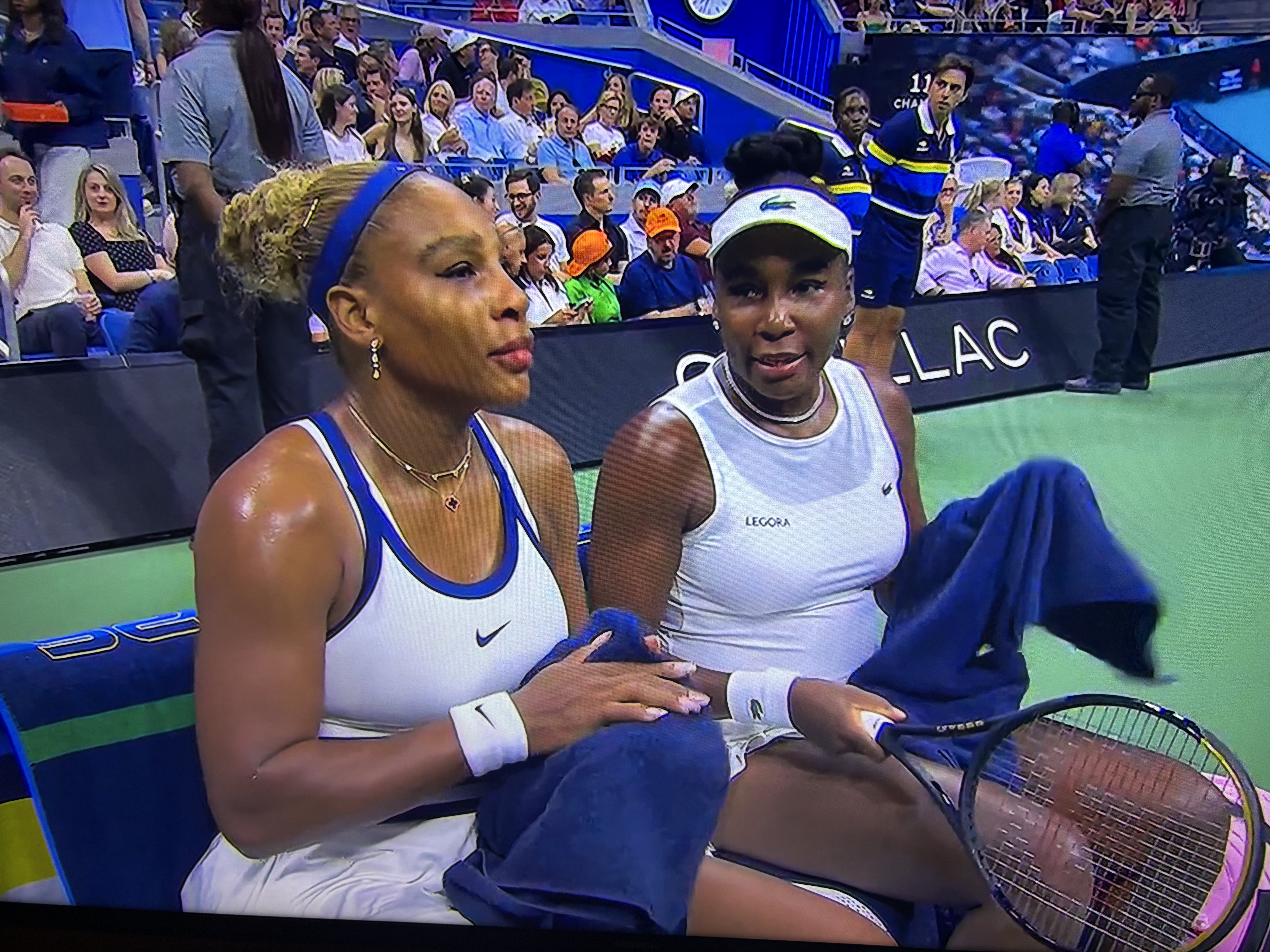
Venus and Serena Williams walked back onto the US Open stage this past week as elder statespeople of a sport they essentially rebuilt from the inside out. They lost. They are well past the years when either could be favored in a major draw. And they could still hang. That combination, the grace of age meeting the muscle memory of genuine greatness, is worth pausing on, because what it represents for Black Americans and for this country runs deeper than any scoreline.
Look at the crowd at Arthur Ashe Stadium and you will see something that did not exist in that form thirty years ago: Black faces, comfortable, knowledgeable, present. Tennis is not a sport Black people merely tolerate or attend out of obligation to two celebrities. It has become a sport many of us feel culturally at home in. When someone in a Charlotte barbershop or an Atlanta community center mentions they play tennis, nobody blinks. That ease has a source, and the source has a name, two of them.
The Williams sisters did not slip into tennis politely. They entered a world that, by its own traditions, its country club economics, its quiet social codes, was not built to receive them. The resistance was real and it was documented. The soccer world is dying for their own Venus and Serena moment with Black Americans. What overcame it was not a publicity campaign or a diversity initiative. It was performance so undeniable that the gatekeepers ran out of arguments. Serena Williams is, by any honest accounting, the greatest tennis player who has ever lived. That sentence should not need a qualifier.
For the Black community, a group that represents a relatively small share of the American population, and even smaller slice of the global population, producing one all-time greatest in any major global sport is extraordinary. Black Americans continue producing greats, kinetic geniuses, at an impossible clip.
Producing that person in a sport with the particular social and economic history tennis carries makes it something else entirely. It is a signal about what this community is capable of when the door opens even a crack, and about the cost of all those decades when the door was held shut. The Williams family did not wait for an invitation that was never coming. They earned their way through by being too good to ignore.
For readers across the world, where tennis programs in public schools are underfunded and private court access remains uneven, this legacy is not abstract. The visibility of Serena and Venus translated into coaching pipelines, junior programs, and a generation of young Black players who saw the sport as theirs to claim. That is an economic and civic fact, not sentiment. As these two women take their final bows at the majors, the honest tribute is not nostalgia. It is to keep building the infrastructure that makes their example mean something concrete in our own communities.