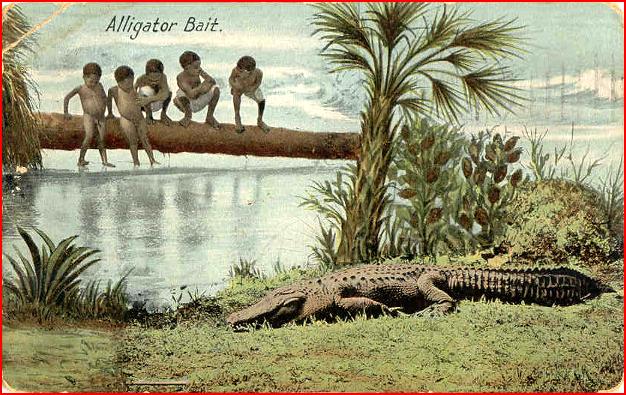
The University of Florida opened its 2025 football season by bringing back the 'Gator Bait' cheer, which its own administration had suspended in 2020 following the murder of George Floyd and a wave of institutional reckonings with racist traditions. The cheer is back. The reckoning, apparently, is over. For anyone paying attention to how this country handles its ugliest chapters, that sequence of events is not surprising. It is, however, worth documenting precisely because the people defending the chant are now leaning on the oldest shield in the American racial playbook: plausible deniability.
The anti-blackness isn't just the chant, it's the boldness in the act, and the fact that they just don't give a damn. Even if black babies were used as gator bait, it was a long time ago and just a joke, they didn't really do stuff like that.... right?
The Wikipedia entry for 'alligator bait' is not ambiguous. The term refers to a practice, documented in newspaper accounts and postcards from the late nineteenth and early twentieth centuries, in which Black infants and small children were used, or described as being used, as bait to lure alligators for hunting. Postcards depicting this were sold as novelty items. The imagery circulated in mainstream American media. This is not a fringe historical claim sourced from one grievance account. It is documented. And yet the standard response from Florida fans and university administrators is some version of: we did not know that, and therefore the chant is innocent.
That reasoning would be more persuasive if ignorance had ever, even once, turned out to be the correct conclusion when applied to a tradition with roots that old, in a region with that history.
Here is the broader problem, and it matters for every community in the Carolinas that has watched a Confederate statue get quietly relocated or a school mascot get defended with the words 'it was a different time.' The historical record of what white America did to Black Americans is not complete. It is not complete because the people keeping records were often the same people committing the acts. The practice of destroying records of atrocities are well documented during this period. What survived in writing is the sanitized version. What survived in memory, in oral tradition, in the stories grandparents told children, is the fuller account. The absence of a formal record is not evidence of innocence. In this country, given this history, the absence of a record is itself a data point, and it does not point toward innocence.
The University of Florida's administration made a calculation. After five years of quiet, they decided the cultural moment had shifted enough that they could restore the cheer without serious consequence. They were probably right about the consequences. They are wrong about the history. And this is where the economic dimension of this story enters the conversation, because universities are economic engines. The University of Florida receives public funding. It recruits Black athletes whose labor generates revenue. It markets itself to a diverse applicant pool. When an institution makes the choice to restore a cheer with this lineage, it is not making a neutral cultural decision. It is signaling, clearly, who the institution believes it ultimately answers to, and who it expects to simply absorb the message and move on.
The rapper Beanie Sigel once said something that applies here with uncomfortable precision: even if you mute it, the curse is there. The chant does not become clean because a generation of students grew up without knowing its origin. The origin does not care about their awareness of it. Truth is not governed by the comfort of the people who benefit from its burial. Every time that cheer goes up in The Swamp, it carries its full history with it, whether the students chanting it can name that history or not. The job of journalists, educators, and community institutions in places like the Carolinas is not to make that history comfortable. It is to make sure it cannot be misplaced again.
So here is where this lands. The University of Florida had a choice, and it made one. Fans who want to continue the cheer can continue it. But they should do so knowing that the people who remember will not stop saying what it means. The benefit of the doubt has been extended in situations like this before, in this country, across centuries, and it has never once turned out to have been extended to a false accusation. Not once. So the cheer can stay if Florida insists. But the history stays with it.
So continue on, and chant proudly with the hopeful innocence yet uneasiness of knowing that it's not the people you'll have to ultimately answer to. Only time will tell whether "gator bait" is really just as innocent as "later alligator", or whether its actually the ghosts of your ancestors tricking you into accepting their sins by extending you a one way ticket to "see you in hell" disguised as a football chant.