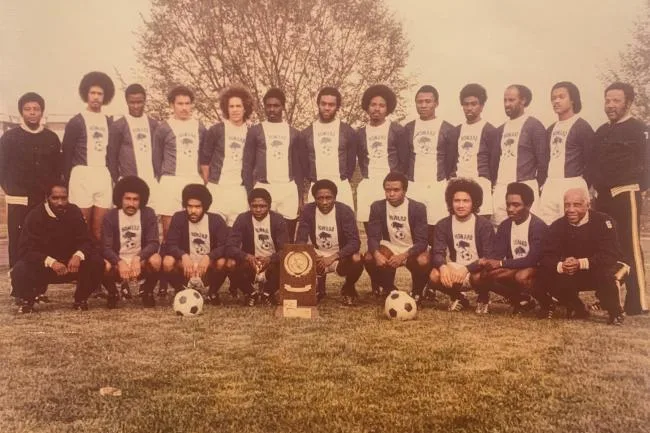
Fifty years ago, a group of young Black men, many of them immigrants from Africa and the Caribbean, won a college soccer national championship that changed the landscape of the sport in America. Howard University Athletics commemorated that achievement on Nov. 3, marking the golden anniversary of the 1974 NCAA title with a recognition dinner for the players and coaches who earned it. The celebration was long overdue, and the story behind it is one that most people, including most sports fans in the Carolinas, have never been told.
The short version is this: Howard, an HBCU in Washington, D.C., believed it had won the national championship in 1971, only to have the NCAA strip the title under "eligibility" rulings that many observers at the time considered racially motivated. The program kept competing, kept recruiting, and in 1974 beat Saint Louis 2-1 in four overtimes to claim the championship a second time, a victory that could not be taken away. Coach Lincoln Phillips, a Trinidadian who built the roster with players from across the African diaspora, later wrote that critics kept assuming his team was a fluke. They were not.
This history is not taught in schools, and it is rarely discussed in the broader conversation about Black athletic achievement, even though it deserves a prominent place in that conversation. Football and basketball dominate that conversation for understandable reasons, but those sports are also where the competition for talent, visibility, and sponsorship dollars is most fierce. Programs at schools like UNC, Duke, Alabama, and Ohio State have generations of infrastructure, brand recognition, and recruiting pipelines that are extraordinarily difficult for newer or smaller programs to challenge. Soccer is a different calculation entirely.
For communities and institutions in the Carolinas, the 1974 Howard story is a useful frame for thinking about where investment and cultural energy might actually find room to grow. The sport is expanding rapidly at the youth and professional levels, the domestic player pool is diversifying, and Black participation, while growing, has not yet produced the kind of deep cultural ownership that it has in football and basketball. That gap is not a problem to be solved. It is a lane that is open, and it has been open for a long time. Howard proved that fifty years ago, and the anniversary is a reminder that the proof exists.
The economic angle is straightforward for Carolinas readers who follow local sports business. Youth soccer club fees, tournament travel, equipment, and coaching represent billions of dollars in spending annually, and those dollars flow overwhelmingly through structures that have not historically centered Black families or Black institutions. HBCUs in the region, community clubs, and independent soccer academies are positioned to build something in this space without needing to go head-to-head with the programs that already own the football and basketball markets. The infrastructure cost is lower, the competition for attention is lighter, and the cultural moment, with Major League Soccer expanding and the 2026 World Cup arriving in the United States, is as favorable as it has ever been.
None of this diminishes what the 1974 Bison actually accomplished on the field, which was remarkable by any measure. These were players who navigated suspensions, probationary seasons, and institutional resistance, and they still won. Their coach fought for their recognition when it was denied. That is a story about character and perseverance, but it is also a story about what becomes possible when the right people commit to a space that others have overlooked. The Carolinas, with its growing immigrant communities, its network of HBCUs, and its expanding soccer infrastructure, has the ingredients to write a version of that story for a new generation.