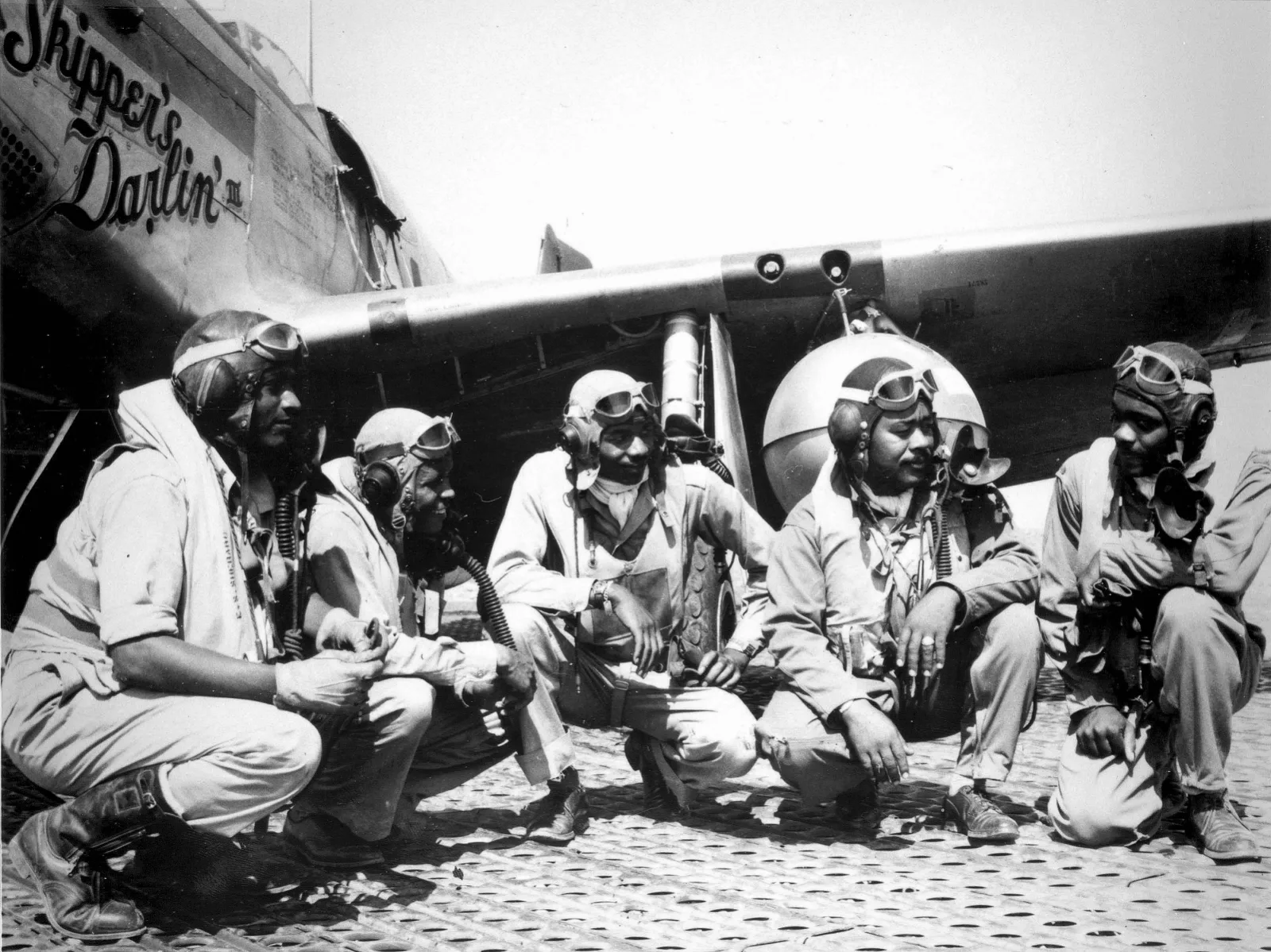
A story that mainstream outlets have largely ignored is getting a second look, thanks to persistent veterans and a historian who refused to let the record stand as written. As Military.com reported, the 332nd Fighter Group, the unit forged from the Tuskegee Airmen program, won the United States Air Force's first-ever aerial gunnery competition in 1949. That fact was buried in official records for 46 years, listed only as 'unknown.'
The competition, held at what is now Nellis Air Force Base in Nevada, was no minor event. The Air Force chief of staff called on every fighter group to send their three best pilots. The field included teams flying the P-51 Mustang and the P-82 Twin Mustang, among the most capable propeller aircraft of that era. The 332nd team, Capt. Alva Temple, 1st Lt. Harry Stewart, 1st Lt. James H. Harvey III and alternate Halbert Alexander, flew the P-47N Thunderbolt, a plane already considered obsolete. They led across five events over ten days and won the trophy outright.
Lt. Col. Harvey, who graduated from the Tuskegee Flight Program in October 1944 and later became the first Black jet pilot in combat during the Korean War, described the silence in the room when the 332nd was announced as the winner. No applause followed. The trophy then disappeared into storage at the National Museum of the United States Air Force at Wright-Patterson Air Force Base in Ohio, where it sat largely unseen for decades. Historian Zellie Rainey Orr eventually located the trophy and documented the full story, leading to its public display in 2004. It was not until January 2022 that Nellis Air Force Base posted a commemorative plaque formally recognizing the win.
This history carries particular weight for communities in the Carolinas, which have long been home to veterans, active-duty families, and a defense economy tied to installations such as Fort Liberty, Camp Lejeune, and Shaw Air Force Base. Black servicemembers from across the South, including the Carolinas, answered the call during and after World War II under conditions designed to limit their opportunities. The Tuskegee program itself was shaped by policies meant to prove Black pilots could not perform. The 332nd proved the opposite, at the highest level of skill the Air Force could measure, and was still made invisible in the official record.
The broader lesson is not simply about aviation history. It is about how institutional erasure works and what it costs communities to recover the record. When a competition winner goes unlisted for 46 years and a trophy sits in a storage room for 55, the knowledge of what was possible, the model for younger generations, disappears with it. For readers in the Carolinas whose families have served in uniform for generations, often without proportional recognition or economic return, the Tuskegee Airmen's story is not a footnote. It is a direct line to questions that still matter today about who gets credit, who builds wealth, and whose contributions get counted.